Screen-free play
Slow Doodle Fill
Slow Doodle Fill turns a familiar quiet moment into a focused 5-minute activity for ages 3–6.
Set aside roughly 5 minutes. The activity is written for ages 3–6 and suits times when you need lower-noise play for a shared space or wind-down. For Slow Doodle Fill, have paper and crayons ready before the first round. Allow about 2 minutes for setup.
Make the first round easy to understand
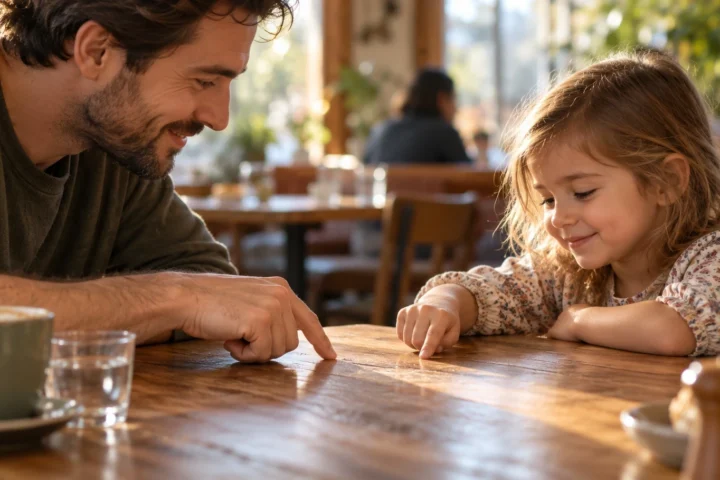
Begin with the normal sequence: Give the child one sheet of paper and two or three large washable crayons. Then draw one loose loop, blob or wandering line that leaves several open spaces. Once that feels clear, invite the child to fill one space at a time with slow marks: dots, stripes, spirals or one chosen color. For Slow Doodle Fill, keep the first round centered on attention and turn taking; there is no benefit in adding extra rules yet.
Watch the pace, not the clock
In Slow Doodle Fill, a few focused minutes are enough; there is no need to repeat the activity until attention is gone. A useful checkpoint comes near the end of the sequence: Switch hands for one section, choose a new pattern for each space.
Know when to stop
A natural place to stop Slow Doodle Fill is after the closing step: Switch hands for one section, choose a new pattern for each space. If the child asks for another round, keep the same setup once more and let attention stay at the center of the quiet and calm play activity.
If Slow Doodle Fill is not the right fit, browse more restaurant games for kids.
What you need
- paper
- crayons
How to play
- Give the child one sheet of paper and two or three large washable crayons.
- Draw one loose loop, blob or wandering line that leaves several open spaces.
- Invite the child to fill one space at a time with slow marks: dots, stripes, spirals or one chosen color.
- There is no need to stay perfectly inside the line.
- Switch hands for one section, choose a new pattern for each space.
Make it easier
Remove extra choices and repeat the same calm version once. For the first try, stop after this part is complete: Draw one loose loop, blob or wandering line that leaves several open spaces. A complete short round of Slow Doodle Fill is enough; do not rush to the full version. Leave the paper arrangement unchanged so the child only has one new thing to manage.
Make it harder
Add one extra thing to remember or compare while keeping the pace calm. Keep the original ending in place: Switch hands for one section, choose a new pattern for each space. Ask for a little more independence with attention before adding another layer of difficulty.
Play together
Sit side by side and alternate who chooses the next object, sound, picture, or prompt. For Slow Doodle Fill, start the shared round with this same first step: Give the child one sheet of paper and two or three large washable crayons. Keep the same rules for the second round, but change who starts.
Two or more players
Use a quiet turn order and let each player choose one prompt, object, sound, or observation. Keep turns short enough that everyone gets a chance. Do not change the basic ending just because more players join: Switch hands for one section, choose a new pattern for each space. A shared finish works better than eliminating players one by one.
Skills practiced
Attention, Turn Taking
Safety
Use age-appropriate, non-toxic drawing materials on a stable surface. Remove broken crayon fragments for children who still mouth objects.
Supervision: Awareness