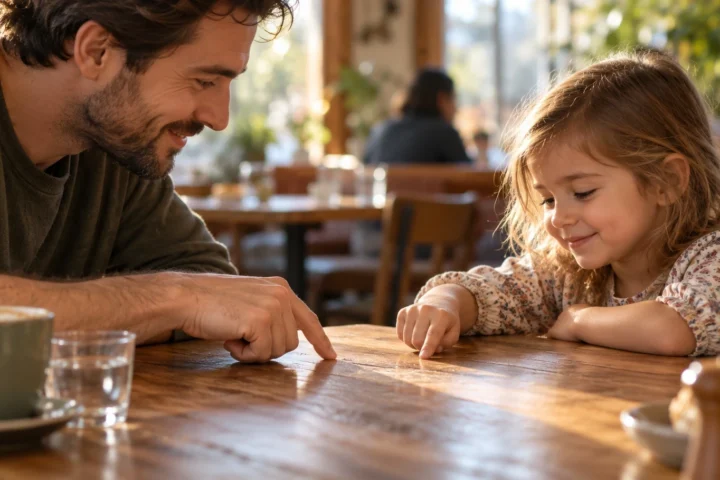
Screen-free play
Find the Smallest Thing
Find the Smallest Thing works best as a small shared experiment rather than a lesson.
Plan on about 5 minutes for ages 2–5. This works especially well when the child needs a low-pressure activity with an obvious stopping point. Find the Smallest Thing needs no special materials, so you can begin without setting anything out first.
Begin with the simplest version
For the first round, follow the instructions in order. First, pick three to five large safe objects already visible in the room. Then point them out so the child knows which objects are part of the comparison. Once that feels clear, ask which is the smallest among two objects first. Let attention and turn taking carry the challenge instead of extra scoring or speed.
Give the child room to respond
In Find the Smallest Thing, allow silence and keep questions sparse enough that the activity stays calm. A useful checkpoint comes near the end of the sequence: Compare objects visually whenever possible.
Close the activity cleanly
A natural place to stop Find the Smallest Thing is after the closing step: Compare objects visually whenever possible. If the child asks for another round, keep the same setup once more and let attention stay at the center of the quiet and calm play activity.
If Find the Smallest Thing is not the right fit, browse more restaurant games for kids.
How to play
- Pick three to five large safe objects already visible in the room.
- Point them out so the child knows which objects are part of the comparison.
- Ask which is the smallest among two objects first.
- Add a third object only after the child understands the comparison.
- Let them point, move closer or explain their choice.
- Compare objects visually whenever possible.
Make it easier
Shorten the round and use one clear prompt at a time. For the first try, stop after this part is complete: Point them out so the child knows which objects are part of the comparison. A complete short round of Find the Smallest Thing is enough; do not rush to the full version. Keep the first round focused on attention and ignore any optional extra challenge.
Make it harder
Let the child lead the next round with fewer reminders. Keep the original ending in place: Compare objects visually whenever possible. Keep turn taking as the thing that becomes more demanding; leave the rest of the rules familiar.
Play together
Sit side by side and alternate who chooses the next object, sound, picture, or prompt. When two people play Find the Smallest Thing, begin exactly as the solo version does: Pick three to five large safe objects already visible in the room. Keep the same rules for the second round, but change who starts.
Two or more players
Use a quiet turn order and let each player choose one prompt, object, sound, or observation. End the round after everyone has had one complete turn. Do not change the basic ending just because more players join: Compare objects visually whenever possible. If the group gets noisy or confused, return to one leader and one turn at a time.
Skills practiced
Attention, Turn Taking
Safety
Compare objects visually whenever possible. Do not encourage reaching high shelves or handling tiny, sharp or breakable items.
Supervision: Awareness