
Screen-free play
What Changed on the Table?
Make a simple ‘what changed?’ game with a few large table objects, using one change at a time.
This activity gives ages 2–5 one clear task for roughly 10 minutes. Pick it when you need lower-noise play for a shared space or wind-down. For What Changed on the Table?, have safe household items within easy reach before the first round. Allow about 1 minute for setup.
Get the first round moving
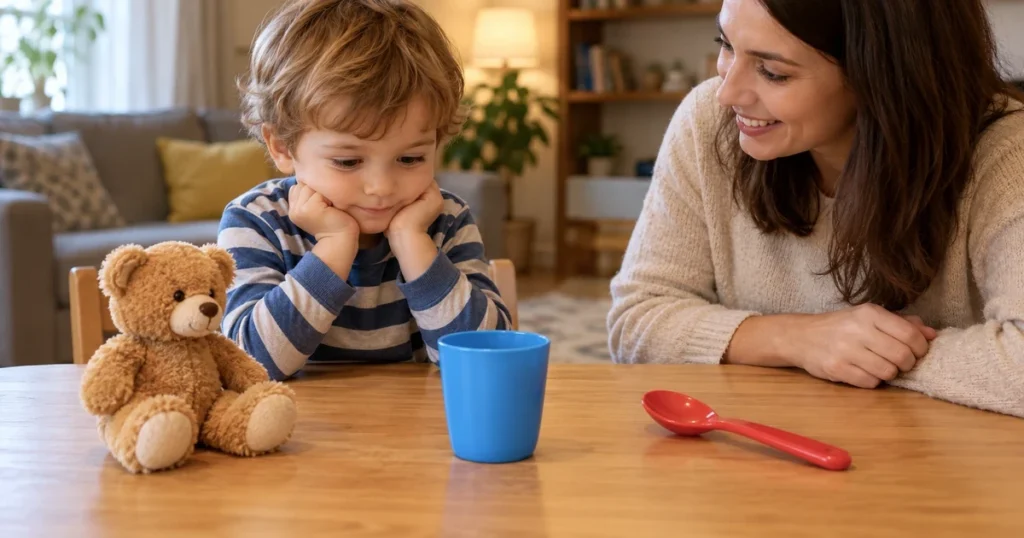
For the first try, use only the activity as written. Place exactly three large safe objects on a stable table, such as a cup, soft toy and large spoon. Then give the child time to study the arrangement and name the objects. Once that feels clear, ask the child to turn around or close their eyes briefly. Let the child settle into attention, working memory, and observation rather than changing several things at once.
Keep choices manageable
In What Changed on the Table?, a few focused minutes are enough; there is no need to repeat the activity until attention is gone. A useful checkpoint comes near the end of the sequence: Ask what changed, then restore the original arrangement before the next round.
When the activity is done
A natural place to stop What Changed on the Table? is after the closing step: Ask what changed, then restore the original arrangement before the next round. If the child asks for another round, keep the same setup once more and let attention stay at the center of the quiet and calm play activity.
If What Changed on the Table? is not the right fit, browse more restaurant games for kids.
What you need
- safe household items
How to play
- Place exactly three large safe objects on a stable table, such as a cup, soft toy and large spoon.
- Give the child time to study the arrangement and name the objects.
- Ask the child to turn around or close their eyes briefly.
- Move one object or swap two positions.
- Ask what changed, then restore the original arrangement before the next round.


Make it easier
Remove extra choices and repeat the same calm version once. For the first try, stop after this part is complete: Give the child time to study the arrangement and name the objects. Stay with this simpler What Changed on the Table? setup until the child is comfortable with it. Leave the household items arrangement unchanged so the child only has one new thing to manage.
Make it harder
Let the child lead the next round with fewer reminders. Keep the original ending in place: Ask what changed, then restore the original arrangement before the next round. Ask for a little more independence with attention before adding another layer of difficulty.
Play together
One person chooses the next prompt and the other responds; switch after a short round. Keep What Changed on the Table? collaborative by using the normal first step: Place exactly three large safe objects on a stable table, such as a cup, soft toy and large spoon. Let the second player lead the next round using the same basic rules.
Two or more players
Use a quiet turn order and let each player choose one prompt, object, sound, or observation. The group round still ends with the original final step: Ask what changed, then restore the original arrangement before the next round. Use the same turn order for the whole round so nobody is skipped.
Skills practiced
Attention, Observation, Working Memory
Safety
Use only large, non-breakable household objects that cannot fit in the child's mouth. Use only sturdy, non-breakable, age-appropriate objects.
Supervision: Direct