Screen-free play
Five-Finger Breathing
Use the five fingers as a visual pacing guide for gentle, natural breathing—never as a medical or therapeutic exercise.
With ages 3–6, allow about 5 minutes from start to finish. This is a useful choice when you want a calm screen-free reset. Five-Finger Breathing needs no special materials, so you can begin without setting anything out first.
Use a workable first step
For the first round, follow the instructions in order. First, hold one hand open. Then explain that a finger from the other hand will slowly travel up and down each finger like a little hill. Once that feels clear, trace up one finger while taking an easy breath if comfortable, then trace down while letting the breath out naturally. Let attention, working memory, and observation carry the challenge instead of extra scoring or speed.
Add challenge only when it helps
In Five-Finger Breathing, a few focused minutes are enough; there is no need to repeat the activity until attention is gone. A useful checkpoint comes near the end of the sequence: Breathing must stay natural and comfortable.
A natural stopping point
A natural place to stop Five-Finger Breathing is after the closing step: Breathing must stay natural and comfortable. If the child asks for another round, keep the same setup once more and let attention stay at the center of the quiet and calm play activity.
If Five-Finger Breathing is not the right fit, browse more restaurant games for kids.
How to play
- Hold one hand open.
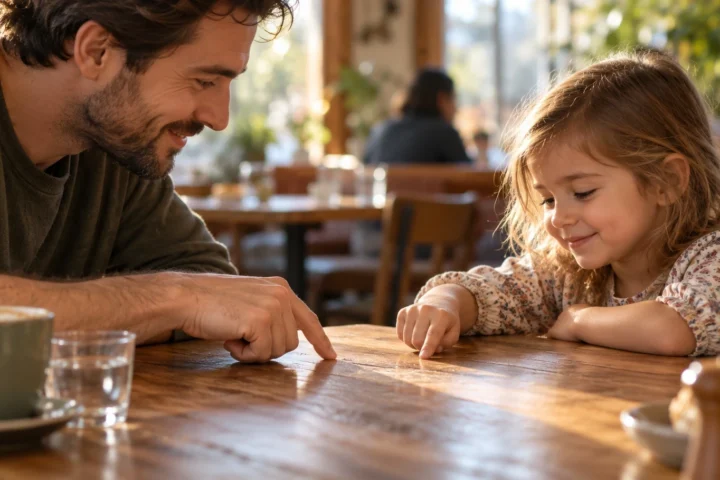
- Explain that a finger from the other hand will slowly travel up and down each finger like a little hill.
- Trace up one finger while taking an easy breath if comfortable, then trace down while letting the breath out naturally.
- The child may also simply trace without matching the breath.
- Breathing must stay natural and comfortable.
Make it easier
Remove extra choices and repeat the same calm version once. For the first try, stop after this part is complete: Explain that a finger from the other hand will slowly travel up and down each finger like a little hill. If that works, keep the next round of Five-Finger Breathing the same before adding anything else. Keep the first round focused on attention and ignore any optional extra challenge.
Make it harder
Let the child lead the next round with fewer reminders. Keep the original ending in place: Breathing must stay natural and comfortable. Keep working memory as the thing that becomes more demanding; leave the rest of the rules familiar.
Play together
One person chooses the next prompt and the other responds; switch after a short round. When two people play Five-Finger Breathing, begin exactly as the solo version does: Hold one hand open. Swap who leads before repeating the round.
Two or more players
Use a quiet turn order and let each player choose one prompt, object, sound, or observation. Keep turns short enough that everyone gets a chance. Do not change the basic ending just because more players join: Breathing must stay natural and comfortable. Keep turns short enough that everyone gets a real chance to lead.
Skills practiced
Attention, Observation, Working Memory
Safety
Breathing must stay natural and comfortable. Never ask a child to hold their breath, breathe deeply on command or continue if they feel dizzy, uncomfortable or uninterested.
Supervision: Awareness