Screen-free play
Finger Maze
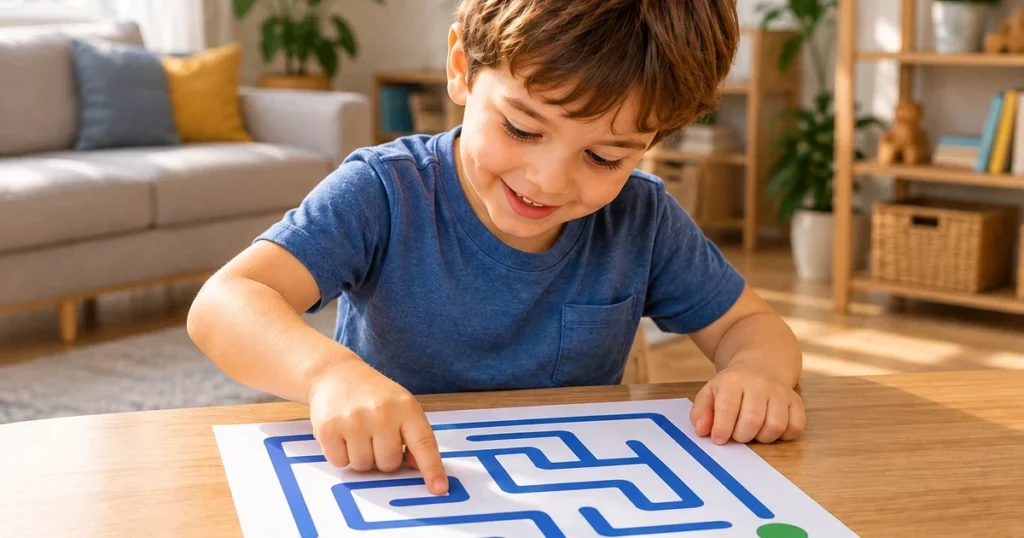
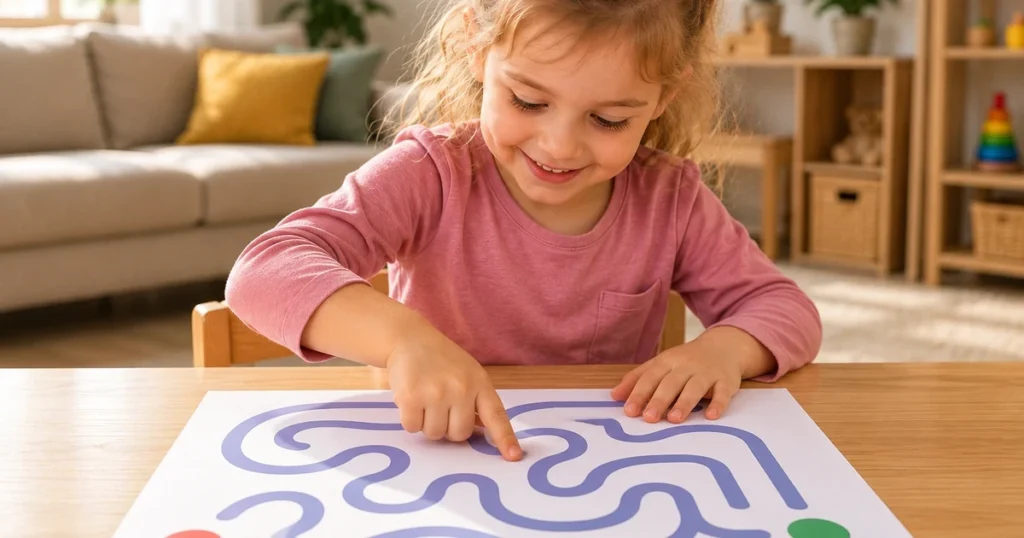
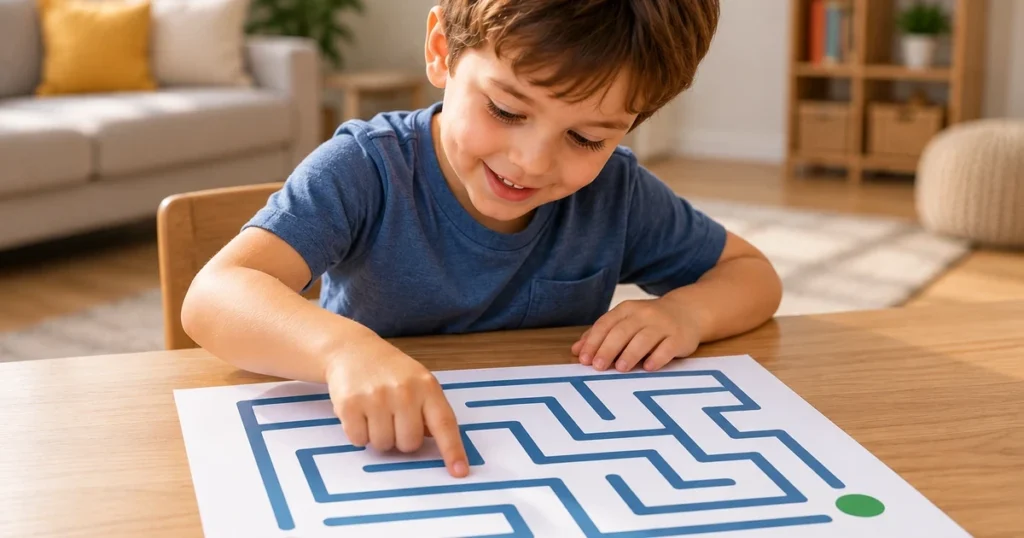
Finger Maze is a quiet table activity that starts with a hand-drawn path and turns it into a small planning puzzle. The child first follows the maze with a finger, then can trace it with a crayon or design a new route for someone else to solve.
Draw a very easy first maze
On one sheet of paper, draw a wide path from a clear starting point to a finish. Use gentle turns and avoid dead ends for the first round. A simple road-like route is enough. The child does not need to read words; you can mark the beginning and end with small symbols.
Trace with a finger before using a crayon
Ask the child to move one finger slowly along the path. This lets them understand the route without worrying about drawing accuracy. On the second attempt, try to stay between the sides. Only then add a crayon if the child wants to make a visible trace.
Make the maze gradually more interesting
Add one branch, a gentle dead end or a narrower section. Older children can look at the correct route for a few seconds and then try to remember it. Keep the page readable; a crowded maze becomes frustrating rather than challenging.
Swap roles
Invite the child to draw a maze for the adult. Even a scribbly route can become a fun puzzle when the child explains where the start and finish should be. At a restaurant or waiting room, role swapping can extend the activity without adding extra supplies.
Playing with siblings
Each child can make one small maze, then swap papers. If ages are different, let the younger child make a wide simple path and the older child add a slightly trickier route on a separate sheet.
Plan before tracing
Before a finger enters the maze, ask the child to scan ahead to the first junction and choose a likely direction. If the route reaches a dead end, return only to the last decision point rather than restarting from the beginning. This turns Finger Maze into a small planning exercise instead of a trial-and-error scribble. The child begins to see dead ends as information about the route.
Keep playing
Finish the round with the final step: Add one or two gentle dead ends, or let the child draw a maze for the adult. After Finger Maze, if you want a different idea, browse more restaurant games for kids.
What you need
- paper
- crayons
How to play
- Draw a wide simple path from START to FINISH on one sheet of paper.
- Ask the child to trace the path slowly with one finger.
- Trace it again without touching the sides.
- Use a crayon to follow the same route.
- Add one or two gentle dead ends, or let the child draw a maze for the adult.
Make it easier
Use only two or three examples in the first round. For the first try, stop after this part is complete: Ask the child to trace the path slowly with one finger. Repeat the easier Finger Maze version once before deciding whether to add another step. Keep the paper setup exactly the same while the child learns the rules.
Make it harder
Ask the child to create the next example or rule after solving the current one. Keep the original ending in place: Add one or two gentle dead ends, or let the child draw a maze for the adult. The extra challenge should still make the child use fine motor, not simply work faster.
Play together
Take turns choosing the clue, rule, or comparison while the other person explains the answer. Use one shared round of Finger Maze and keep the opening simple: Draw a wide simple path from START to FINISH on one sheet of paper. After one complete round, switch roles so both players get to lead.
Two or more players
Rotate who sets the clue or problem; everyone else gets one answer or explanation before the next round. Do not change the basic ending just because more players join: Add one or two gentle dead ends, or let the child draw a maze for the adult. If the group gets noisy or confused, return to one leader and one turn at a time.
Skills practiced
Fine Motor, Planning, Visual Tracking
Safety
Use age-appropriate crayons and keep materials on the table. Avoid small detachable drawing accessories for younger children.
Supervision: Awareness