
Screen-free play
Cup Stack Countdown
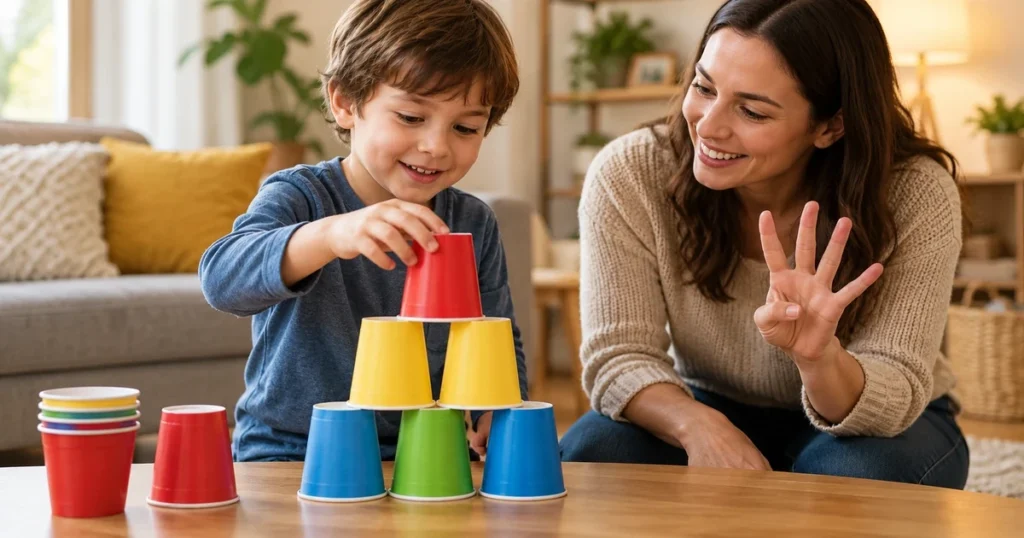
Build a cup tower, knock it down by hand, then rebuild it before the countdown ends. Start with six to ten lightweight plastic or paper cups. Build a simple pyramid together once.
Start without the timer
Use plastic or paper cups and build one small pyramid together. Six cups are enough for a first round. Let the child see how the bottom row supports the cups above it, then take the tower apart and place the cups within easy reach.
Add the countdown only when the shape is familiar
Once the child can rebuild the tower, start counting slowly from ten. If the tower falls, simply restart or continue without resetting the whole round. The number is not a test. Adjust the pace so the child has a good chance to finish.
Change the building challenge
Try a taller narrow tower, a wide wall or a shape copied from the adult. Older children can look at a model for five seconds before rebuilding it from memory. Another strong variation is to ask for two different stable designs using the same number of cups.
Let the child count for the adult
Role reversal keeps the game from feeling like an adult-controlled task. The child becomes the timer while the adult builds. Deliberately making one small mistake can make the round more playful and gives the child a chance to explain how to fix the structure.
Playing with siblings
Give each child the same number of cups and ask them to build different shapes rather than racing. They can then compare which tower is tallest, widest or easiest to rebuild. Cooperative building also works well: take turns placing one cup at a time.
Make the countdown change the build
Cup Stack Countdown works best when the numbers control what happens next. Count down slowly from five while the child adds or removes one cup at each number, then stop completely at zero and look at the structure. On another round, reverse the job: build while counting up and dismantle while counting down. This connects number order with a visible change in the stack instead of turning counting into background noise.
Keep playing
Finish the round with the final step: Adjust the countdown so the challenge stays fun, then let the child count for the adult. After Cup Stack Countdown, if you want a different idea, browse more travel activities for kids.
What you need
- cups
How to play
- Start with six to ten lightweight plastic or paper cups.
- Build a simple pyramid together once.
- Take the cups down and mix them beside the child.
- Count slowly from ten while the child rebuilds the tower.
- Adjust the countdown so the challenge stays fun, then let the child count for the adult.


Make it easier
Build a smaller version with fewer pieces or one simple design goal. For the first try, stop after this part is complete: Build a simple pyramid together once. If that works, keep the next round of Cup Stack Countdown the same before adding anything else. Do not introduce a second material until the child is comfortable using cups in this version.
Make it harder
Ask for one planned improvement after the first test. Keep the original ending in place: Adjust the countdown so the challenge stays fun, then let the child count for the adult. Ask for a little more independence with fine motor before adding another layer of difficulty.
Play together
Take turns making one change to the build, testing after each change. Use one shared round of Cup Stack Countdown and keep the opening simple: Start with six to ten lightweight plastic or paper cups. Let the second player lead the next round using the same basic rules.
Two or more players
Assign one builder at a time while the group suggests or checks one design goal. Keep turns short enough that everyone gets a chance. Do not change the basic ending just because more players join: Adjust the countdown so the challenge stays fun, then let the child count for the adult. Keep turns short enough that everyone gets a real chance to lead.
Skills practiced
Fine Motor, Hand Eye Coordination, Planning
Safety
Use lightweight, unbreakable cups. Keep cups away from the face and do not use glass.
Supervision: Awareness