Screen-free play
Paper Path Challenge
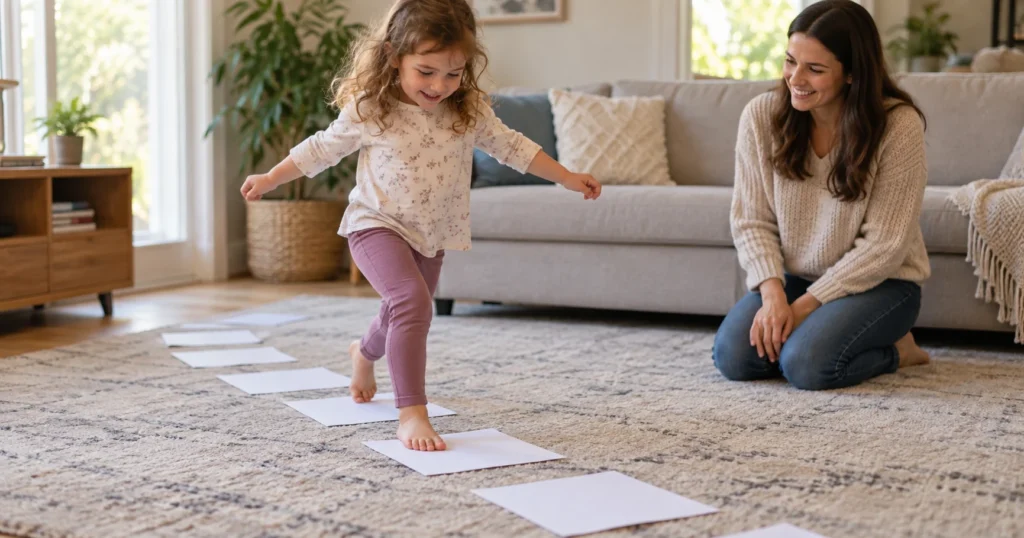
Lay sheets of paper on the floor and travel across the room without stepping off the path. Place six to ten sheets of paper on a clear floor to make a short path.
Build the first path
Choose six to ten sheets and place them on a clean floor with comfortable gaps. For younger children, keep the sheets almost touching. On a very smooth floor, paper can slide, so test each sheet before play. If it moves under your foot, use a safer surface or switch to flat cardboard pieces that stay in place.
Cross slowly before making it harder
The first goal is simply to travel from one end to the other without stepping outside the path. Ask the child to look at the next sheet before moving. Once the route feels easy, turn one sheet slightly or increase one gap by a small amount. There is no need for long jumps.
Let the child redesign the route
After a successful crossing, invite the child to move one or two sheets. This turns the activity from a balance task into a planning game. Older children can try to create a path for the adult, then watch whether their design is easy, tricky or impossible.
Useful variations
Give one sheet a special rule: pause for two seconds, touch your knees, or turn around before continuing. A color route can assign a different action to each sheet. A memory version works well for older children: cross once, rebuild the route and see whether it matches the first layout.
Playing with more than one child
Use one child on the path at a time so there is no crowding or pushing. While one crosses, the other can choose the next safe change. If there is enough room, two separate short paths are better than having children compete for the same landing spots.
Let one sheet become a route decision
Add a single junction where the child must choose between two paper sheets before continuing. One route can be shorter while the other includes a pause or turn. Ask the child to look ahead and choose before stepping. After crossing, move only the junction sheets and try again. This adds simple route planning without turning Paper Path Challenge into a larger obstacle course.
Keep playing
Finish the round with the final step: Let the child design the final path for the adult. After Paper Path Challenge, if you want a different idea, browse more activities for 4-year-olds.
What you need
- paper
How to play
- Place six to ten sheets of paper on a clear floor to make a short path.
- Start with the sheets close enough for comfortable steps.
- Ask the child to cross without touching the floor outside the paper.
- Move one or two sheets to create a new route.
- Let the child design the final path for the adult.


Make it easier
Use a smaller play area and repeat the same movement before adding another. For the first try, stop after this part is complete: Start with the sheets close enough for comfortable steps. A complete short round of Paper Path Challenge is enough; do not rush to the full version. Keep the paper setup exactly the same while the child learns the rules.
Make it harder
Add one direction change, balance demand, or remembered movement without increasing speed. Keep the original ending in place: Let the child design the final path for the adult. The extra challenge should still make the child use balance, not simply work faster.
Play together
Take turns leading the route or movement while the other player follows at a controlled pace. Use one shared round of Paper Path Challenge and keep the opening simple: Place six to ten sheets of paper on a clear floor to make a short path. Swap who leads before repeating the round.
Two or more players
Use a fixed turn order and enough space for one child to move at a time; the others wait outside the route. Keep turns short enough that everyone gets a chance. Use the normal final step to close the group round: Let the child design the final path for the adult. If the group gets noisy or confused, return to one leader and one turn at a time.
Skills practiced
Balance, Coordination, Planning
Safety
Direct adult supervision is recommended. Paper can slide on smooth floors; use a stable surface, test every sheet, keep the route away from stairs and hard furniture, and stop if any sheet shifts.
Supervision: Direct