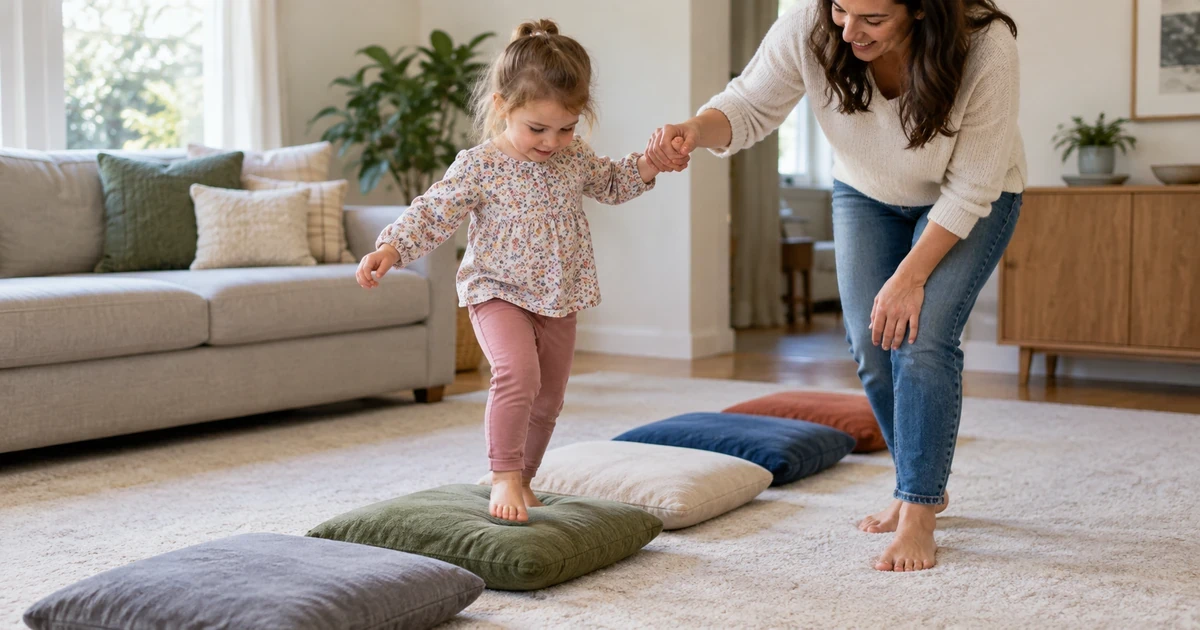

Screen-free play
Jump the River
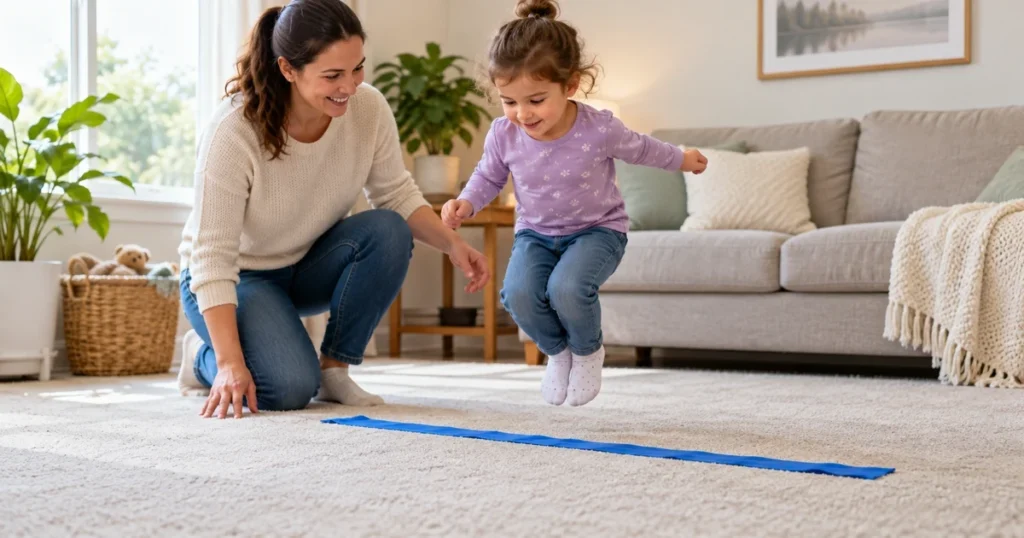
Jump the River is a simple indoor jumping game built around one imaginary line: the child stands on one bank and makes a small two-foot jump to the other side. The “river” starts very narrow. The challenge grows only if the child is landing comfortably, keeping balance and enjoying the repetition.
No markers are required
You can describe an imaginary river across a section of carpet and point to the two banks. If the child needs a visual cue, use existing rug patterns or two flat pieces of paper that stay well outside the landing zone. The activity works best when the child is watching the landing space rather than a complicated setup.
Start smaller than you think
For the first jump, the two banks can be almost next to each other. Ask the child to bend a little, jump forward with both feet and land softly. Once that looks controlled, move the far bank only a small amount. A wider gap is not automatically a better game.
Keep the story alive
The river might contain sleepy fish, floating leaves or an imaginary bridge that disappeared. The child can choose what lives in the water. Story details help the same small jump stay interesting without pushing distance or height.
Parent tip
Pay more attention to the landing than the takeoff. If the child lands off balance, takes several uncontrolled steps or falls forward, make the river narrower. Stop before fatigue changes the movement. A few successful jumps are enough.
Ways to change the challenge
Try a “quiet landing,” freeze for two seconds after landing, or let the child choose where the next narrow river begins. An older child can make a sequence of two small rivers with walking space between them. Do not add furniture, raised obstacles or long-distance leaps.
What to notice
The activity uses lower-body coordination, force control and landing balance. Because the challenge is easy to scale, the child can experience success quickly and still have room to progress.
Keep playing
Finish the round with the final step: Stop the round before the child becomes tired or starts making large uncontrolled jumps. After Jump the River, if you want a different idea, browse more activities for 4-year-olds.
How to play
- Choose a clear flat area with a stable, non-slippery landing surface.
- Point out an imaginary narrow river with two banks very close together.
- Ask the child to make one small two-foot jump across.
- Check that the landing is balanced and controlled.
- Widen the imaginary river only slightly after several easy landings.
- Stop the round before the child becomes tired or starts making large uncontrolled jumps.

Make it easier
Use a smaller play area and repeat the same movement before adding another. For the first try, stop after this part is complete: Point out an imaginary narrow river with two banks very close together. A complete short round of Jump the River is enough; do not rush to the full version. Let the child complete one clear use of jumping before repeating the round.
Make it harder
Add one extra movement or route decision while keeping the same safe pace. Keep the original ending in place: Stop the round before the child becomes tired or starts making large uncontrolled jumps. If the harder round stops using jumping, remove the extra rule and return to the original version.
Play together
One player demonstrates a short movement and the other copies it, then reverse roles. When two people play Jump the River, begin exactly as the solo version does: Choose a clear flat area with a stable, non-slippery landing surface. One round each is enough before deciding whether to continue.
Two or more players
Use a fixed turn order and enough space for one child to move at a time; the others wait outside the route. End the round after everyone has had one complete turn. Keep the same finish for the group version: Stop the round before the child becomes tired or starts making large uncontrolled jumps. If the group gets noisy or confused, return to one leader and one turn at a time.
Skills practiced
Balance, Jumping, Landing Control
Safety
Use a clear flat surface with good traction and plenty of landing space. Keep the river narrow. Do not jump over furniture, objects or other children, and do not encourage maximum-distance jumps.
Supervision: Direct