
Screen-free play
Tape Line Missions
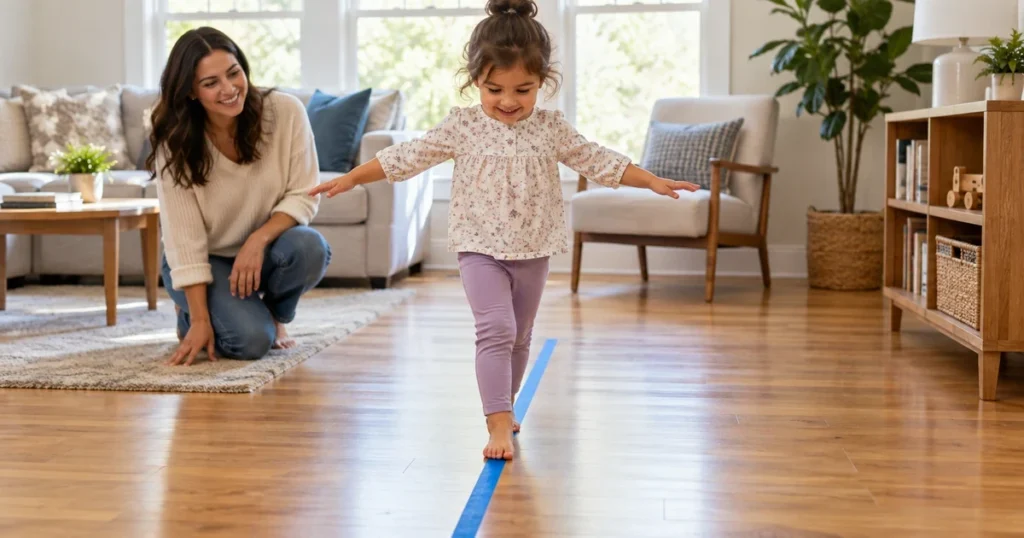
Tape Line Missions turns one strip of removable floor tape into a balance route, pretend bridge and movement prompt. The line gives children a clear visual path while the mission changes from round to round, so a very simple setup can support several kinds of play.
Make one simple line first
Place removable floor-safe tape on a clean dry surface. Start with a straight line rather than a complicated shape. Walk it once normally so the child understands that the tape is only a guide. Stepping off the line is always allowed; this is not a balance test.
Add a mission
Choose one movement rule: tiny steps, sideways steps, slow robot steps or a freeze halfway. Keep the rule simple enough that the child can still watch where they are going. After each successful trip, change the mission instead of making the line narrower or more dangerous.
Turn the line into pretend play
The tape can become a bridge over an imaginary river, a path through a jungle or a delivery route between two pretend stations. A story often makes a short route feel new without adding any extra equipment.
Let the child invent a rule
After a few adult-led rounds, ask the child to create the next mission. Children may choose a movement, a sound or a place to pause. If the idea is unsafe or too difficult, keep the playful theme and simplify the action together.
Playing with siblings
One child uses the line while the other chooses the next mission. Switch after each turn. This avoids crowding and gives the waiting child a useful role. A second line can be added only if there is enough clear floor space.
Give each tape line a different job
Instead of treating every line as a path to walk, assign simple missions: one line is for heel-to-toe steps, another is for side steps, and a short line may be a stop-and-balance zone. The child has to notice which line they reached before choosing the movement. Keeping the missions visibly different makes Tape Line Missions a cue-reading game as well as a movement activity.
Keep playing
Finish the round with the final step: Let the child invent the final movement rule. After Tape Line Missions, if you want a different idea, browse more activities for 4-year-olds.
What you need
- tape
How to play
- Put one long strip of removable tape on a clean floor.
- Walk along the line normally once.
- Choose a mission: tiny steps, sideways steps, freeze halfway, or walk like a robot.
- Complete three different missions.
- Let the child invent the final movement rule.


Make it easier
Use a smaller play area and repeat the same movement before adding another. For the first try, stop after this part is complete: Walk along the line normally once. Repeat the easier Tape Line Missions version once before deciding whether to add another step. Do not introduce a second material until the child is comfortable using tape in this version.
Make it harder
Let the child choose and remember a short movement sequence, then repeat it with control. Keep the original ending in place: Let the child invent the final movement rule. If the harder round stops using balance, remove the extra rule and return to the original version.
Play together
Take turns leading the route or movement while the other player follows at a controlled pace. Keep Tape Line Missions collaborative by using the normal first step: Put one long strip of removable tape on a clean floor. Swap who leads before repeating the round.
Two or more players
Use a fixed turn order and enough space for one child to move at a time; the others wait outside the route. End the round after everyone has had one complete turn. The group round still ends with the original final step: Let the child invent the final movement rule. Do not add scoring unless competition genuinely improves the game.
Skills practiced
Balance, Body Control, Following Instructions
Safety
Use removable floor-safe tape and a clean, dry floor. The line is a visual guide, not a tightrope—children may step off whenever balance is lost. Use a flat, dry, uncluttered movement area away from stairs and hard furniture; stop if balance or control deteriorates.
Supervision: Direct


