

Screen-free play
Ball Roll Bowling
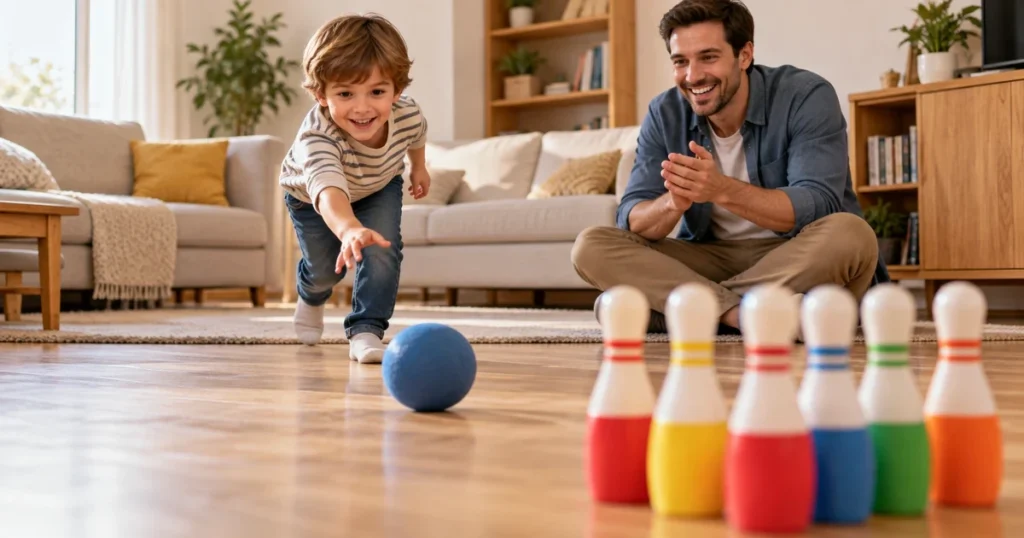
Roll a soft ball down a clear lane to knock over lightweight pretend pins, then reset and compare how many pins fall. Set up three to six lightweight pins in a small cluster.
Choose safe pins
Use empty plastic cups or lightweight cardboard tubes if available. If you have no pins, choose a floor target instead. Place everything away from glass, stairs and furniture legs.
Practice the roll
Show the child how to push the ball forward along the floor rather than throwing it. Start close enough that the ball reaches the target easily. The first goal is control, not knocking down every pin.
Move the starting line slowly
After several comfortable rolls, move back one small step. If the child starts throwing or using too much force, move closer again.
Make simple scoring optional
Older children may enjoy counting how many pins fall, but the game works just as well without points. A cooperative version counts how many total pins the family can knock down in five rolls.
Let the child reset the lane
Setting the cups back up can become part of the game. Keep the lane clear before the next roll begins.
Why this version works indoors
Keeping the ball on the floor reduces wild rebounds and gives children more time to judge direction and force. A short lane also makes it easy to reset the game without turning the room into a running area.
Make resetting part of the game
Let the child help stand the lightweight pins back up after each roll. That small reset keeps the activity cooperative and slows the pace naturally. Try placing the pins in a straight line, a small triangle, or a wide gate and notice how the roll changes. The goal is not power: a smooth ball that stays on the floor is the useful skill, so bring the start line closer whenever hard throws begin.
Change the pin pattern, not the throwing force
Set the targets in a simple triangle, straight line or wide gate and let the child notice how the arrangement changes the roll. Keep the same starting line for several attempts. A miss gives useful information about direction, while a ball that stops early gives information about force. Ball Roll Bowling becomes more thoughtful when the child adjusts from the result instead of simply rolling harder.
Keep playing
Finish the round with the final step: Change the starting distance only after the child can keep the ball in the lane. After Ball Roll Bowling, if you want a different idea, browse more activities for 4-year-olds.
What you need
- ball
How to play
- Set up three to six lightweight pins in a small cluster.
- Choose a soft ball and a clear rolling lane.
- Roll the ball along the floor to knock down the pins without throwing.
- Wait until the ball stops, then count and reset the fallen pins.
- Change the starting distance only after the child can keep the ball in the lane.

Make it easier
Shorten the route and use one movement at a time. For the first try, stop after this part is complete: Choose a soft ball and a clear rolling lane. If that works, keep the next round of Ball Roll Bowling the same before adding anything else. Do not introduce a second material until the child is comfortable using ball in this version.
Make it harder
Add one extra movement or route decision while keeping the same safe pace. Keep the original ending in place: Change the starting distance only after the child can keep the ball in the lane. Keep force control as the thing that becomes more demanding; leave the rest of the rules familiar.
Play together
One player demonstrates a short movement and the other copies it, then reverse roles. When two people play Ball Roll Bowling, begin exactly as the solo version does: Set up three to six lightweight pins in a small cluster. Reverse the roles for the next round rather than adding another rule.
Two or more players
Use a fixed turn order and enough space for one child to move at a time; the others wait outside the route. Use the normal final step to close the group round: Change the starting distance only after the child can keep the ball in the lane. Use the same turn order for the whole round so nobody is skipped.
Skills practiced
Aim, Coordination, Force Control, Turn Taking
Safety
Use a soft lightweight ball and unbreakable targets. Keep the lane clear of people, stairs, glass and breakables. Roll only; do not throw indoors.
Supervision: Direct
