Screen-free play
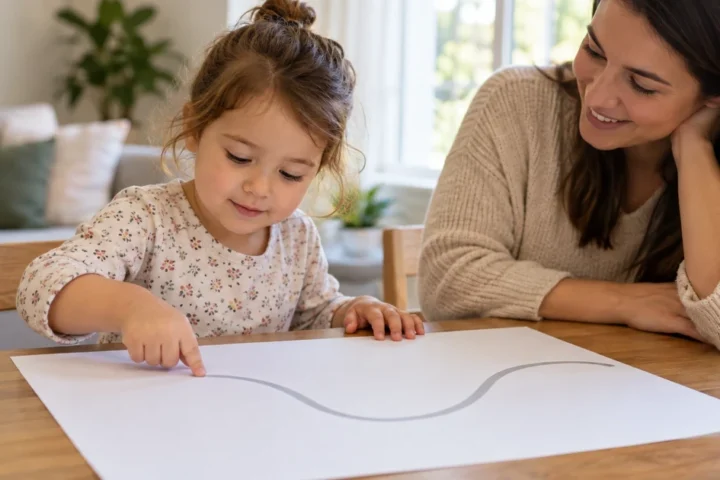
Water Brush Marks on Cardboard
Paint temporary dark marks on cardboard using only water, then watch the marks fade as they dry.
For ages 2–5, this is roughly a 15-minute activity. Use it when you want a small sensory comparison rather than a large messy setup. For Water Brush Marks on Cardboard, have water, cardboard, and safe household items ready before the first round. Allow about 3 minutes for setup.
Keep setup short
Keep the opening version easy to read. Dip a broad brush in a small amount of water. Next, brush one line on cardboard. Once that feels clear, make a second line with more or less water. Water Brush Marks on Cardboard already gives one complete round of sensory discrimination, descriptive language, and fine motor before any variation is introduced.
Build from the first successful round
In Water Brush Marks on Cardboard, pointing or matching is enough; the child does not have to describe every sensation in words. A useful checkpoint comes near the end of the sequence: Watch the marks lighten as they dry.
Stop while it is still working
A natural place to stop Water Brush Marks on Cardboard is after the closing step: Watch the marks lighten as they dry. If the child asks for another round, keep the same setup once more and let sensory discrimination stay at the center of the sensory play activity.
If Water Brush Marks on Cardboard is not the right fit, browse more activities for 4-year-olds.
What you need
- water
- cardboard
- safe household items
How to play
- Dip a broad brush in a small amount of water.
- Brush one line on cardboard.
- Make a second line with more or less water.
- Compare darkness and width.
- Watch the marks lighten as they dry.
Make it easier
Offer only one or two familiar materials at first. For the first try, stop after this part is complete: Brush one line on cardboard. A complete short round of Water Brush Marks on Cardboard is enough; do not rush to the full version. Leave the water arrangement unchanged so the child only has one new thing to manage.
Make it harder
Compare one additional property, such as texture, weight, sound, or flexibility. Keep the original ending in place: Watch the marks lighten as they dry. Keep descriptive language as the thing that becomes more demanding; leave the rest of the rules familiar.
Play together
Take turns selecting and comparing materials, with either player free to skip a texture they dislike. Keep Water Brush Marks on Cardboard collaborative by using the normal first step: Dip a broad brush in a small amount of water. Swap who leads before repeating the round.
Two or more players
Offer one safe sample or comparison per turn and let any player skip a sensation they do not want. Keep turns short enough that everyone gets a chance. The group round still ends with the original final step: Watch the marks lighten as they dry. Stop after everyone has had one complete turn unless the group asks for another round.
Skills practiced
Descriptive Language, Fine Motor, Observation, Sensory Discrimination
Safety
Direct adult supervision is required around water. Use only shallow room-temperature water, clean spills immediately and never leave a child alone with a water container.
Supervision: Direct