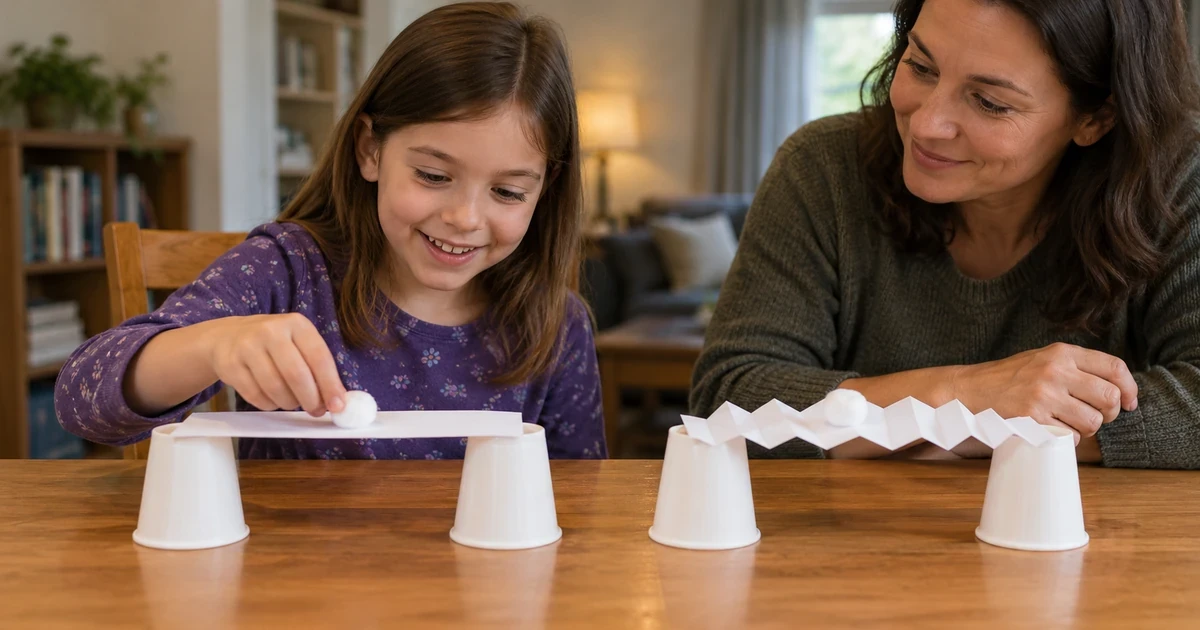
Screen-free play
Cup-and-Card Tower
Alternate cups and flat cards to create a tower whose stability depends on level alignment rather than on stacking identical pieces.
This is a practical 20-minute option for ages 5–8, especially when you have a few materials ready for a hands-on build. For Cup-and-Card Tower, have paper, cups, and blocks ready before the first round. Allow about 3 minutes for setup.
Make the rules obvious
Start with one complete, ordinary round. Place two or more cups as the first supports. Then lay one card flat across the cup tops. Once that feels clear, add the next cup level near the center of the card. If that is working, leave the rules alone and let the child concentrate on spatial reasoning, engineering thinking, and problem solving.
Keep the activity useful
In Cup-and-Card Tower, build, test, and change one thing at a time so the effect of each change is visible. A useful checkpoint comes near the end of the sequence: Stop and rebuild the first level that begins to tilt.
Finish without forcing another round
A natural place to stop Cup-and-Card Tower is after the closing step: Stop and rebuild the first level that begins to tilt. If the child asks for another round, keep the same setup once more and let spatial reasoning stay at the center of the building and making activity.
If Cup-and-Card Tower is not the right fit, browse more activities for 5-year-olds.
What you need
- paper
- cups
- blocks
How to play
- Place two or more cups as the first supports.
- Lay one card flat across the cup tops.
- Add the next cup level near the center of the card.
- Continue only while each level remains steady.
- Stop and rebuild the first level that begins to tilt.
Make it easier
Reduce the build to one section that can be completed and tested quickly. For the first try, stop after this part is complete: Lay one card flat across the cup tops. Repeat the easier Cup-and-Card Tower version once before deciding whether to add another step. Leave the paper arrangement unchanged so the child only has one new thing to manage.
Make it harder
Add one design constraint and test whether the build still works. Keep the original ending in place: Stop and rebuild the first level that begins to tilt. Keep engineering thinking as the thing that becomes more demanding; leave the rest of the rules familiar.
Play together
One person places or builds while the other checks the agreed goal; swap after the test. Keep Cup-and-Card Tower collaborative by using the normal first step: Place two or more cups as the first supports. Reverse the roles for the next round rather than adding another rule.
Two or more players
Assign one builder at a time while the group suggests or checks one design goal. End the round after everyone has had one complete turn. Use the normal final step to close the group round: Stop and rebuild the first level that begins to tilt. Keep turns short enough that everyone gets a real chance to lead.
Skills practiced
Engineering Thinking, Planning, Problem Solving, Spatial Reasoning
Safety
Keep builds below face height and away from feet. Use lightweight materials, no standing on furniture, and clear fallen pieces before rebuilding.
Supervision: Awareness