Screen-free play
Road Sign Hunt
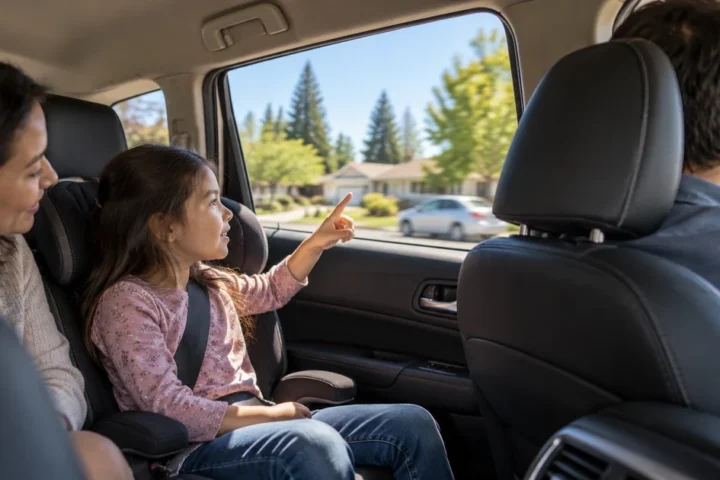
Road Sign Hunt gives children a concrete reason to look outside: find a short set of familiar road signs, colors or shapes as the journey continues. It works best when the list matches the roads you are actually traveling on.
Begin with visual features, not traffic lessons
For younger children, a sign can simply be “a red circle,” “a blue square” or “a triangle.” Older children may know the purpose of a stop, parking or pedestrian sign. The activity is about noticing symbols, not testing formal road knowledge.
Make the list local
Road signs are not identical around the world. Choose examples your child already sees where you live rather than copying a list from another country. Three common sign types are better than ten rare ones.
Use comparison when two signs appear
If the child spots two signs with different shapes or colors, ask what changed. This turns the hunt into a visual-discrimination game without requiring reading. Children who can read may also notice numbers, arrows or short words.
Give the round a natural finish
A list of three to five signs is enough. When it is complete, stop for a while rather than immediately starting another hunt. Short rounds make the activity useful on both everyday drives and longer trips.
Keep the driver out of the search
The safest version is entirely passenger-led. Nobody needs the driver to confirm a sighting, point at a sign or look away from traffic. If a sign has already passed, let it go and wait for the next one.
Use signs the child actually recognizes
Road signs work well as visual targets because their shapes and colors are designed to be noticed quickly. Keeping the activity local also gives children repeated exposure to symbols they genuinely encounter.
For a different spotting game, browse Car Games for Kids.
How to play
- Choose three to five sign types that are common on the route.
- Passengers look for them from their normal seated positions.
- Call out the sign when it appears and, if known, say what it means.
- Start a new list only after the current one is complete or the route changes.
Make it easier
Start Road Sign Hunt with the simplest complete round. Choose three to five sign types that are common on the route. Passengers look for them from their normal seated positions. Give the child time to get comfortable before continuing. A complete short round of Road Sign Hunt is enough; do not rush to the full version. Let the child complete one clear use of symbol recognition before repeating the round.
Make it harder
Make the next round slightly harder with one extra target or rule, but keep it quiet enough that it never distracts the driver. For Road Sign Hunt, change only one part of the challenge at a time. If the harder round stops using symbol recognition, remove the extra rule and return to the original version.
Play together
Take turns leading Road Sign Hunt. One person begins with: Choose three to five sign types that are common on the route. The other continues with: Call out the sign when it appears and, if known, say what it means. Reverse the roles after one complete round. Only non-driving passengers take turns, and everyone stays buckled. When two people play Road Sign Hunt, begin exactly as the solo version does: Choose three to five sign types that are common on the route. Swap who leads before repeating the round.
Two or more players
With several non-driving passengers, keep Road Sign Hunt cooperative. Rotate who leads, answers, or takes the main turn so everyone gets one chance, and keep the driver out of the game. Keep the same finish for the group version: Start a new list only after the current one is complete or the route changes. Use the same turn order for the whole round so nobody is skipped.
Skills practiced
Observation, Symbol Recognition, Visual Discrimination
Safety
Passengers only. Do not ask the driver to point out signs or explain them while driving. Sign designs vary by country, so use familiar local examples. The driver never counts as a player. If looking outside makes anyone feel dizzy, queasy or motion-sick, stop the visual game and switch to a verbal one.
Supervision: Awareness