Screen-free play
Quiet Looking Minute
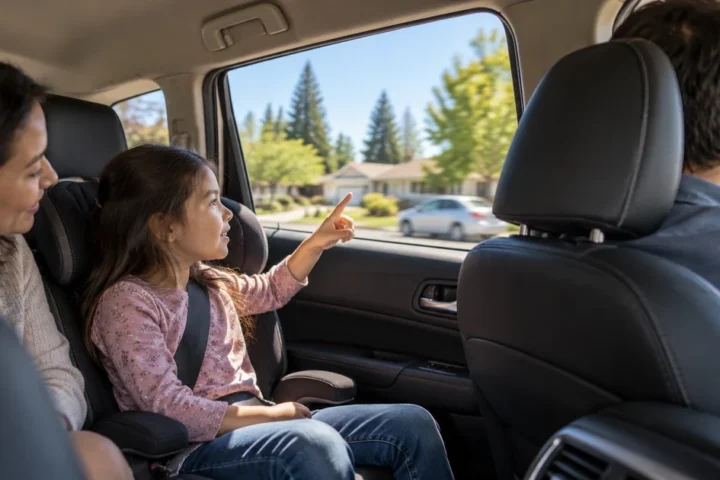
Quiet Looking Minute is intentionally less busy than most road-trip games. Everyone who wants to play spends a short period simply noticing the view, then shares the details that remained in memory.
Keep the quiet period genuinely short
A full minute can feel surprisingly long to a young child. Thirty seconds is enough for a first try. The purpose is not perfect silence; it is a brief change of pace between louder conversations and games.
Do not announce discoveries during the minute
A red truck, a dog, a bridge or a strange tree can all be remembered silently. Waiting until the end gives the child a small working-memory challenge and stops one loud sighting from dominating everyone else’s attention.
Compare different memories
One passenger may remember vehicles while another remembers colors or buildings. There is no master list, so nobody can be wrong about noticing something another person missed.
Use a theme if the route feels repetitive
Try “remember three signs,” “notice five colors” or “look for things that changed.” A narrow theme makes a second round feel different without adding materials.
Switch activities if looking out feels uncomfortable
Children who become motion-sick may do better with forward-looking or verbal games. The quiet minute should feel settling, not physically unpleasant.
A quiet reset between louder games
This activity earns its place because it deliberately lowers stimulation instead of adding more. The brief quiet interval can reset the mood between talk-heavy games while still giving the child something concrete to notice and remember.
If the group wants to become more active again, choose a new idea from Car Games for Kids.
How to play
- Agree on one quiet minute.
- Passengers notice the view without calling things out.
- When the minute ends, each person names details they remember.
- Choose a theme for a second round only if everyone wants one.
Make it easier
Make the first Quiet Looking Minute round short and predictable. Agree on one quiet minute. Passengers notice the view without calling things out. Stop there if that already feels satisfying, and add the remaining steps later. Stay with this simpler Quiet Looking Minute setup until the child is comfortable with it. Keep the first round focused on observation and ignore any optional extra challenge.
Make it harder
Add one extra clue, category, or memory step while everyone stays buckled and the driver remains outside the game. For Quiet Looking Minute, change only one part of the challenge at a time. Ask for a little more independence with observation before adding another layer of difficulty.
Play together
Share the work in Quiet Looking Minute. One player starts with: Agree on one quiet minute. The second player takes the next main action: When the minute ends, each person names details they remember. Swap jobs on the next try. Only non-driving passengers take turns, and everyone stays buckled. When two people play Quiet Looking Minute, begin exactly as the solo version does: Agree on one quiet minute. Reverse the roles for the next round rather than adding another rule.
Two or more players
With several non-driving passengers, keep Quiet Looking Minute cooperative. Rotate who leads, answers, or takes the main turn so everyone gets one chance, and keep the driver out of the game. Use the normal final step to close the group round: Choose a theme for a second round only if everyone wants one. A shared finish works better than eliminating players one by one.
Skills practiced
Memory, Observation, Self Regulation
Safety
Passengers only. Stay in a normal buckled position and stop visual games if anyone feels motion-sick. The driver never counts as a player.
Supervision: Awareness