Screen-free play
Find Five From the Window
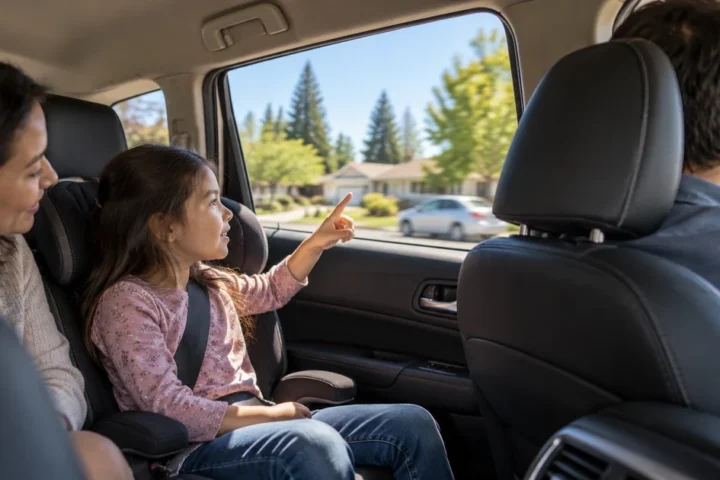
Find Five From the Window turns almost any route into a small scavenger hunt without cards, pencils or preparation. One person chooses a category, and the passengers work together to find five different examples outside.
Choose categories that fit the route
A suburban drive might work with dogs, bicycles, mailboxes or red doors. A highway may be better for trucks, bridges, signs or vehicles with trailers. The strongest categories are broad enough to succeed but specific enough that the child has to look carefully.
Keep one shared list
A cooperative list works better than racing. A child seated on the left may notice things another passenger cannot see, and everyone still contributes to the same target. Repeats do not count unless you decide otherwise before the round starts.
Use language as part of the game
After each find, ask for one useful detail: “What color was it?” or “What made it fit our category?” This adds vocabulary and classification practice without turning the activity into a lesson.
Let children set the next challenge
Once a round is finished, the child can choose the next category. If they pick something too narrow, help them widen it rather than letting the search drag on. “Purple buses” can become “purple things.”
A scavenger hunt should stay easy to stop
The route matters more than the rules. If scenery disappears, light changes or someone feels travel-sick, end the round. A good car game should make the journey feel shorter, not demand constant attention.
End while the search is still fun
Because every route offers different raw material, the same category can produce a different list on every drive. This makes the game especially reusable without needing new printables or preparation.
For a different kind of road-trip challenge, browse more Car Games for Kids.
How to play
- Choose one broad category such as animals, signs, round things or things that are blue.
- Set a target of five examples.
- Passengers call out each new example they can see from their own seats.
- When five are found, choose a different category.
Make it easier
Start Find Five From the Window with the simplest complete round. Choose one broad category such as animals, signs, round things or things that are blue. Set a target of five examples. Give the child time to get comfortable before continuing. Repeat the easier Find Five From the Window version once before deciding whether to add another step. Keep the first round focused on observation and ignore any optional extra challenge.
Make it harder
Add one extra clue, category, or memory step while everyone stays buckled and the driver remains outside the game. For Find Five From the Window, change only one part of the challenge at a time. Keep classification as the thing that becomes more demanding; leave the rest of the rules familiar.
Play together
Play Find Five From the Window as a two-person team. One player handles: Choose one broad category such as animals, signs, round things or things that are blue. The other handles: Passengers call out each new example they can see from their own seats. Swap roles for the next round. Only non-driving passengers take turns, and everyone stays buckled. Keep Find Five From the Window collaborative by using the normal first step: Choose one broad category such as animals, signs, round things or things that are blue. Keep the same rules for the second round, but change who starts.
Two or more players
With several non-driving passengers, keep Find Five From the Window cooperative. Rotate who leads, answers, or takes the main turn so everyone gets one chance, and keep the driver out of the game. The group round still ends with the original final step: When five are found, choose a different category. Keep turns short enough that everyone gets a real chance to lead.
Skills practiced
Classification, Observation, Vocabulary
Safety
Passengers stay seated and restrained. Only count things visible without leaning, turning around or blocking another passenger’s view. The driver never counts as a player. If looking outside makes anyone feel dizzy, queasy or motion-sick, stop the visual game and switch to a verbal one.
Supervision: Awareness