Screen-free play
Count the Red Cars
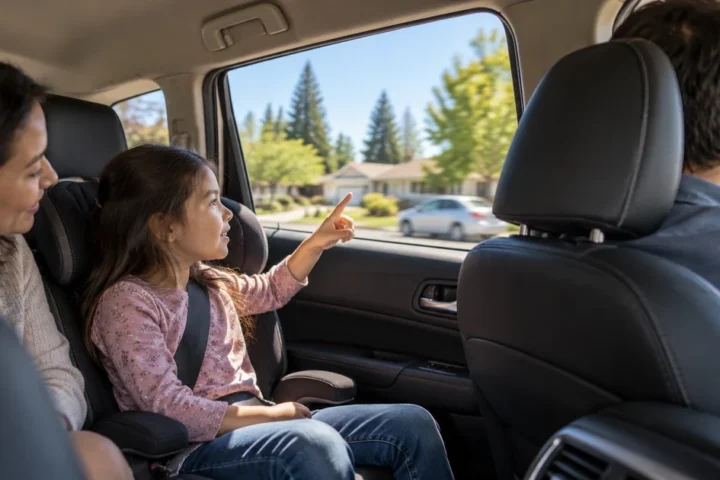
Count the Red Cars is a tiny observation game for the moments when a child needs something to do but nobody wants to unpack supplies. Choose one color, set a small target and count only the matching cars that can be seen from the child’s own seat.
Start with a target that can actually be reached
Five is usually enough for a first round. A short target creates a clear finish and prevents the game from becoming background noise for the entire journey. On a busy road, ten may work; on a quiet route, switch to any vehicle in the chosen color.
Use the game for real counting practice
Ask the child to say each number once as a matching car appears. If they lose track, restart from the last number they are sure about instead of correcting every mistake. Younger children can point and count to three; older children can keep two color totals at once.
Change one thing between rounds
When the target is reached, change the color, the vehicle type or the target number. Small changes make the same game feel new without adding complicated rules. You can also ask a quick prediction: “Which will we see first, five red cars or five white cars?”
Best moments for this game
It works well on school runs, in slow traffic and at the beginning of a longer road trip when attention is still fresh. It is less useful on dark roads or routes where very few vehicles are visible.
Keep the view comfortable
The child should only use the view available from a normal buckled position. There is no reason to turn around, lean across another passenger or ask the driver to help spot cars. When the search stops being easy, end the round.
Choose a finish line before you start
A single-color target is simple enough for young children but still gives the ride a clear mini-goal. Short rounds also make it easy to stop before the search becomes tiring.
More quick passenger games are available in Car Games for Kids.
How to play
- Choose one easy-to-recognize car color, such as red.
- The child counts only cars of that color that are visible from their own seat.
- Stop at a small target such as five or ten.
- Choose a different color for the next round instead of continuing indefinitely.
Make it easier
Start Count the Red Cars with the simplest complete round. Choose one easy-to-recognize car color, such as red. The child counts only cars of that color that are visible from their own seat. Give the child time to get comfortable before continuing. A complete short round of Count the Red Cars is enough; do not rush to the full version. Keep the first round focused on counting and ignore any optional extra challenge.
Make it harder
For a harder round, track two colors separately or predict which color will reach five first. Keep the target small enough that passengers can look forward comfortably and finish the round before attention turns into staring.
Play together
Play Count the Red Cars as a two-person team. One player handles: Choose one easy-to-recognize car color, such as red. The other handles: The child counts only cars of that color that are visible from their own seat. Swap roles for the next round. Only non-driving passengers take turns, and everyone stays buckled. For Count the Red Cars, start the shared round with this same first step: Choose one easy-to-recognize car color, such as red. Keep the same rules for the second round, but change who starts.
Two or more players
With several non-driving passengers, keep Count the Red Cars cooperative. Rotate who leads, answers, or takes the main turn so everyone gets one chance, and keep the driver out of the game. The group round still ends with the original final step: Choose a different color for the next round instead of continuing indefinitely. Do not add scoring unless competition genuinely improves the game.
Skills practiced
Attention, Counting, Observation
Safety
Passengers only. Stay buckled and look only through the windows visible from your normal seated position. The driver never counts as a player. If looking outside makes anyone feel dizzy, queasy or motion-sick, stop the visual game and switch to a verbal one.
Supervision: Awareness